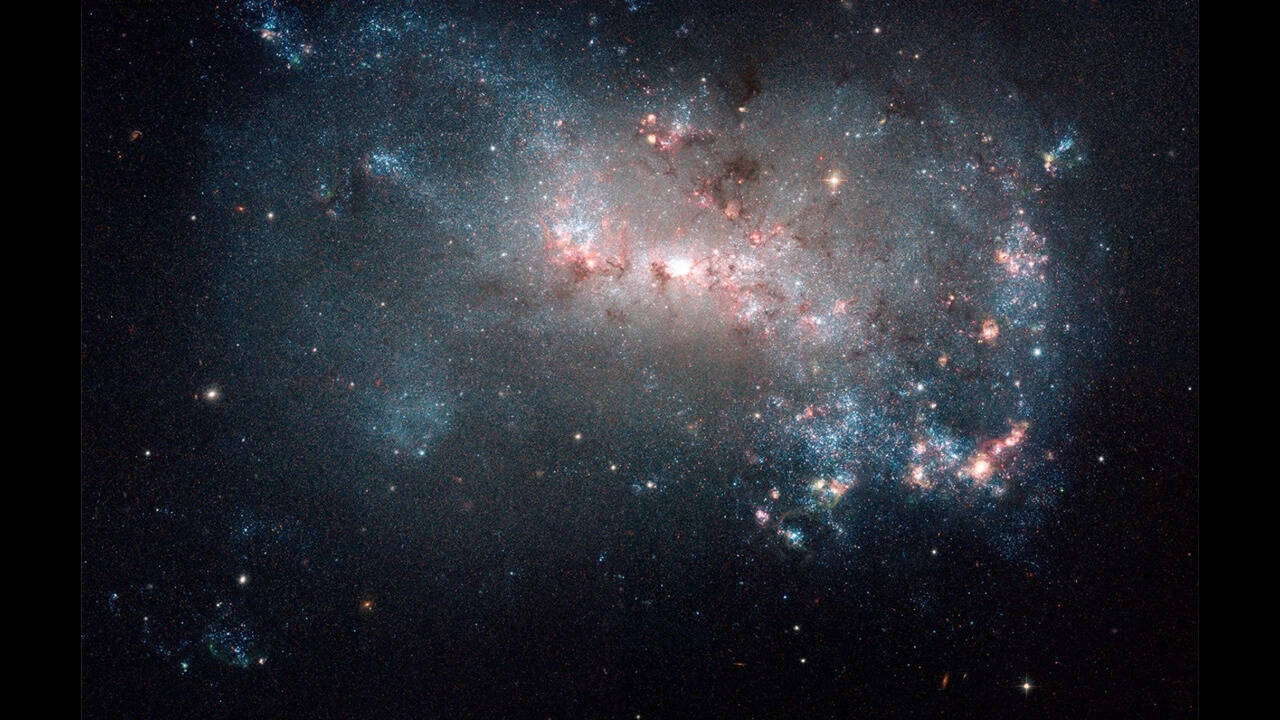
Hubble Space Telescope Finds Dwarf Galaxies Lose Most Star Oxygen
Published 1w ago · Latest report 1w ago · Discovery
Covered in 2 countries
Dwarf galaxies lose 89% of their stellar oxygen to deep space during supernova explosions.
Researchers analyzing nearby dwarf galaxies with the Hubble Space Telescope discovered they retain just 11% of the oxygen produced by their stars. Powerful supernova explosions likely propel the missing material out into deep space. This loss demonstrates that smaller stellar systems struggle to hold onto building blocks compared to larger galaxies.
- The retention rateDwarf galaxies hold an average of only 11% of the oxygen their stars create.
- Future researchScientists plan to investigate where the escaped oxygen ultimately accumulates.
Why it matters
Understanding how galaxies retain or lose heavy elements like oxygen helps astronomers model galactic evolution and the cycle of matter in the universe. Dwarf galaxies serve as crucial laboratories because their weaker gravitational pull makes it easier to observe galactic winds and stellar feedback.
Timeline2
- Nov 2Researchers using NASA's Hubble telescope reported that nearby dwarf galaxies have less oxygen than expected.
- Nov 5An investigation revealed dwarf galaxies retain just 11% of their stellar oxygen due to supernova explosions.
By the numbers1
How outlets cover it
What outlets agree on
Astronomers using the Hubble Space Telescope found that nearby dwarf galaxies contain far less oxygen than anticipated based on stellar generation models.
In this story
Covered by 2 outlets
50% of the sources are Center
Lean ratings via Media Bias/Fact Check
- The Times of IndiaNASA's Hubble studied dwarf galaxies and found they kept just 11% of the oxygen made by their stars1w ago · open ↗
- UPIThe case of the missing oxygen: Hubble telescope research highlights mystery1w ago · open ↗
Similar stories

What people are saying
Opens a search on that site in a new tab. Posts there are not ours and are not checked.
The headline, summary and key points are AI-generated from the sources above.
Comments