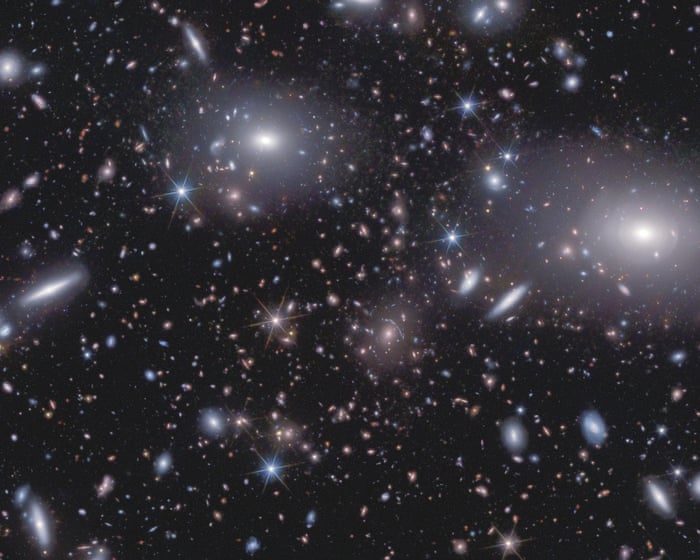
Euclid space mission reveals nine hundred million galaxies in first data release
Published 9h ago · Discovery
Covered in 2 countries
Euclid's first major data release maps over 900 million galaxies to probe the dark universe.
The European Space Agency's Euclid mission published its first major dataset, mapping more than 900 million galaxies. Launched in 2023, the project aims to construct the largest three-dimensional map of the cosmos to investigate dark energy and dark matter. The initial release also highlights thousands of gravitational lensing examples.
- The scopeThe survey will ultimately cover a third of the sky and span over 10 billion years of cosmic history.
- The lensingResearchers identified about 15,000 potential instances of gravitational lensing to help study the dark universe.
Why it matters
Mapping the distribution of galaxies across billions of years allows scientists to better understand the invisible forces driving the expansion of the cosmos. This mission provides astronomers with unprecedented observational depth to explore cosmic history.
By the numbers3
How outlets cover it
What outlets agree on
The European Space Agency's Euclid mission released its initial data, mapping more than 900 million galaxies and thousands of gravitational lensing cases.
In this story
Covered by 2 outlets
50% of the sources are Left
Lean ratings via AllSides, Media Bias/Fact Check
- The GuardianEuropean survey reveals 900m galaxies – and possibly secrets of ‘dark universe’9h ago · open ↗
- CNAEuclid mission data release spans more than 900 million galaxies9h ago · open ↗
Similar stories



What people are saying
Opens a search on that site in a new tab. Posts there are not ours and are not checked.
The headline, summary and key points are AI-generated from the sources above.
Comments