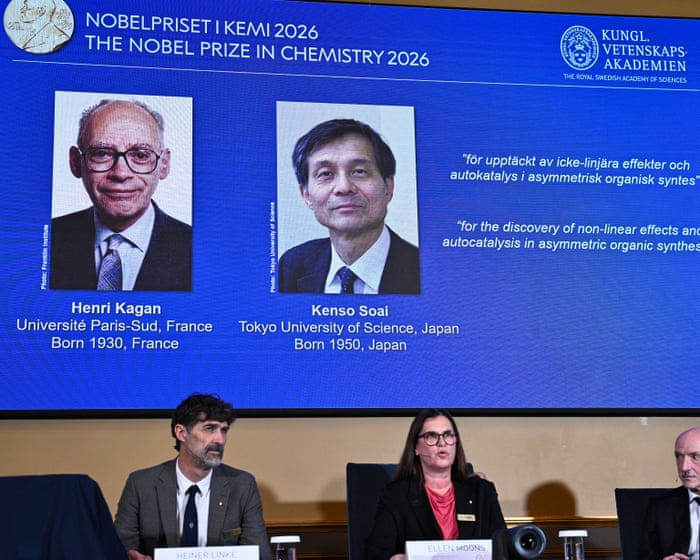
Two Scientists Win Nobel Chemistry Prize for Mirror Image Molecules
Published 3h ago · Latest report 1h ago
Covered in 3 countries
Henri B Kagan and Kensō Soai won the Nobel chemistry prize for solving molecule chirality mysteries.
Henri B Kagan and Kensō Soai have received the Nobel prize in chemistry for groundbreaking research into asymmetric organic synthesis. Their work explains why nature predominantly favours a single version of certain mirror-image molecules. The findings advanced understanding of chemical reactions that produce specific chiral forms.
- Henri B Kagan is affiliated with Paris-Sud University in France.
- Kensō Soai conducts research at the Tokyo University of Science in Japan.
- The award recognises discoveries involving nonlinear effects and autocatalysis.
Written from 2 of 3 outlets — 1 has since joined this story.
1 new report since this summary was written 1h ago
Not in the AI summary yet. It is rewritten once enough new coverage arrives.
Why it matters
The Nobel prizes are among the most prestigious international accolades awarded annually for outstanding contributions to science, literature, and peace.
What outlets agree on
Henri B Kagan and Kensō Soai were awarded the Nobel prize in chemistry for their research into asymmetric organic synthesis and mirror-image molecules.
In this story
Covered by 3 outlets
67% of the sources are Left
Lean ratings via Media Bias/Fact Check, AllSides
- Al JazeeraAfter summaryHenri Kagan, Kenso Soai win Nobel chemistry prize for ‘mirror image’ work1h ago · open ↗
- RTÉNobel chemistry duo solve molecule single handedness1h ago · open ↗
- The GuardianNobel prize in chemistry awarded for work on mirror-image molecules3h ago · open ↗
Similar stories



The headline, summary and key points are AI-generated from the sources above.
Comments